
A name earned seven times over
Yamashita’s Gyokuro carries the name of our master gyokuro craftsman, the late Yamashita Toshikazu. His family is part of our family operation in Kyotanabe, and our Tamiya family has remained the exclusive wholesaler of his gyokuro ever since.
Yamashita-san spent his career as head of the Gyokuro Research Department at Fugenji Plantations, the company that would become Maiko Tea. He is the recipient of the Minister of Agriculture, Forestry, and Fisheries top prize seven times over, first in 1966 and most decisively in 1970, when a second national win led Fugenji Plantations to rename itself Maiko no Cha.
At age thirty-six he received the Chairperson’s Prize from the National Agriculture, Forestry, and Fisheries’ Promotion Committee, an honor given to only twelve people nationwide. He was named a Master Craftsman of Kyoto, then Master Craftsman of Present Japan by the Japanese Ministry of Labour. In 1991 he demonstrated his hand-rolling technique, Temomi, to the Emperor and Empress of Japan, and in 1995 the Prime Minister awarded him the Sixth-class Order of the Sacred Treasure. His Gyokuro Takumi was named Japan’s highest tea prize in 2015, at the Japanese Tea Award in Tokyo.
Today the gardens are cared for by his grandson, Shinki Yamashita, who has built an award record of his own. He won his first prize at the 2019 Kansai Tea Fair, then took the Kansai Tea Competition’s Gyokuro category three years running. In 2022 he won his first national MAFF Award at the National Tea Competition, and that year’s harvest sold at the highest price in the history of the Japanese Tea Auction.
Why hand-kneading still matters
Gyokuro is Maiko’s other hero product alongside matcha, and Kyotanabe is where it is at its best. Our tea gardens sit in southern Kyoto Prefecture, close to Uji, in a basin climate of warm summers and cold winters that suits gyokuro particularly well. From mid-April until harvest the plants are grown under cover, in what is called “ooishita en,” shaded from direct sun. That shading is what concentrates the amino acids, particularly L-theanine, that give gyokuro its deep umami and natural sweetness.
Picking is done by hand, using a finger-pinch method called shigokitsumi that protects the leaf from the bruising a blade or machine would cause. Only a few kilograms can be harvested this way in a day. The leaves are steamed and cooled immediately to stop fermentation, then kneaded entirely by hand, a process so exacting that only fifteen percent of the original leaf weight remains by the time it is finished. Three kilograms of fresh leaf takes four to five hours to knead and yields five hundred grams of finished tea.
Most gyokuro producers abandoned hand-kneading long ago in favor of machines. Yamashita-san kept it precisely because it let him examine every leaf and set aside anything damaged, and his grandson holds the same standard today. It is slower than machine processing. It is also why the tea tastes the way it does.
Six teas, one family’s name
Hand-processed in the family’s Kyotanabe gardens, from an accessible daily cup to the rare Yashiki no Cha.
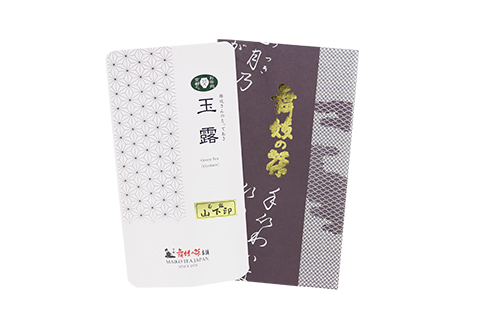
Yamashita-Jirushi
The most accessible way into the range. Soft and sweet at lower temperatures, clean and refreshing at higher ones.
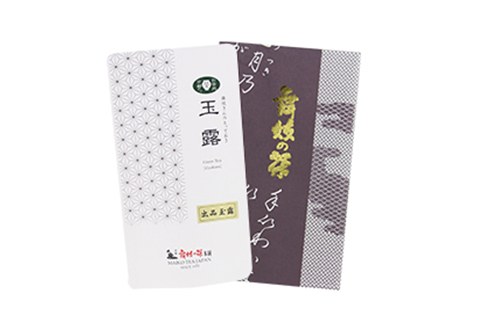
Shuppin-Gyokuro
Prepared each year for Japan’s national tea exhibition, blending the best of that season’s harvest.
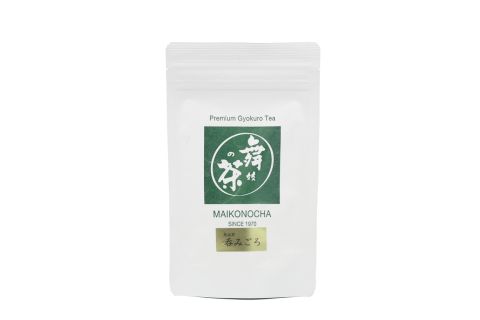
Nomigoro
Kept in cold storage for about five years to deepen its sweetness, the way good wine matures.
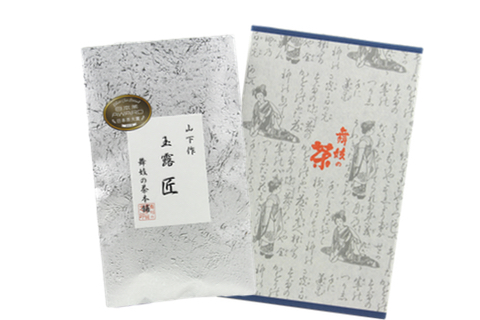
Takumi
Named Japan’s highest tea prize in 2015. Thick leaves and an emerald color, with sweetness that holds through four or five infusions.
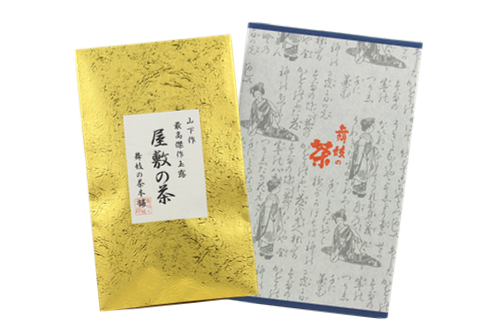
Yashiki no Cha
Grown in the gardens surrounding Yamashita-san’s own residence. Condensed sweetness, in only a few kilograms a year.
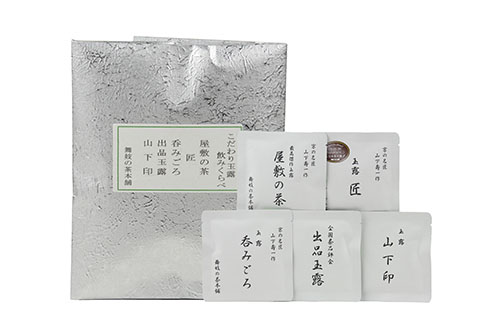
5 High-Quality Gyokuro Set
Five teas, 8g each: Yamashita-Jirushi, Shuppin-Gyokuro, Nomigoro, Takumi, and Yashiki no Cha, in one tasting box.
Steeped slow, sipped slower
Water cooled to about 40°C and a two-minute steep are what set gyokuro apart from an ordinary cup. Our brewing guide shows the rest.